Meditations on Faith in a World Observed

Month: April 2024

The most colorful place on earth

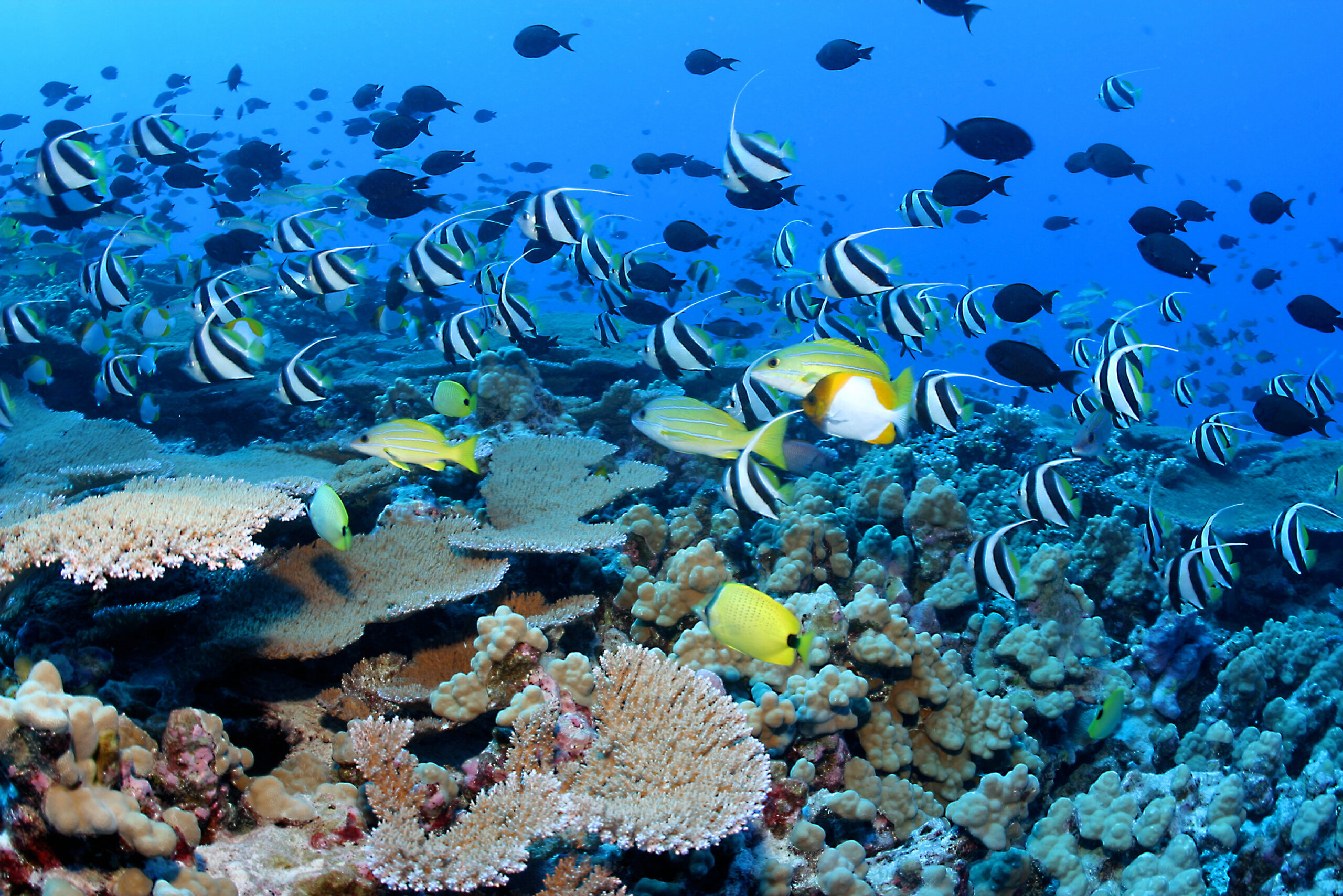
Though they may look like plants, corals are made up of tiny animals called polyps. Coral polyps can take many forms. They may be large reef-building colonies, graceful flowing fans, and even small, solitary organisms. Thousands of species of corals have been discovered. Some live in warm, shallow, tropical seas and others in the cold, dark depths of the ocean. Coral reefs are some of the most diverse and colorful ecosystems in the world. An estimated 2 million species inhabit the coral reefs, rivaling the biodiversity of the rainforest on land. The reefs are home to various species of fish, crabs, mollusks, sponges, and algae. They are the protective habitat for young fish as they grow and have been the food source for many years for coastal peoples. But the burning of fossil fuels – coal, oil and natural gas – pumps excessive amounts of greenhouse gases into the atmosphere. Much of the carbon dioxide is absorbed by the ocean. Global warming would be much worse if it were not for the buffering effect of the ocean. But now the ocean itself becomes warmer and more acidic. These two things together threaten the health of the corals. They also cause the colorful color to bleach out into a white hue. In addition, warm water cannot hold as much oxygen as cold water. And so less oxygen is available for aquatic life under the sea. In his encyclical “On Care for our Common Home”, Pope Francis wrote that “every intervention in nature can have consequences that are not immediately evident”. With the psalmist, we pray: “How varied are your works, O Lord! …There is the sea, great and wide! It teems with countless beings, living things both large and small.” (Psalm 104). We have a duty to protect the most colorful place on earth. – – – Fr. Jim

I will love you and honor you

My parents never read books about parenting, and they never instructed their six children on how to behave. They modeled it for us, and then corrected us when we goofed up. Dad was only involved in one club – the Knights of Columbus – so that he could mostly be at home with his kids. Mom worked at a dry cleaner because they let her off work before we got home from school each day. Dad always invited me to help with his little household projects. Mom was a shy Iowa farm girl who never liked wearing dresses. Dad was a city boy who loved to tease her, and they smooched in the kitchen while she was cooking dinner. Summers were hot in east Texas, and on some nights we all slept on the floor in the living room because it was the only room with an AC unit. Those were my favorite times because Mom and Dad slept right there next to us. My parents never judged anyone by the color of their skin or the religion they professed. When Dad suffered a loss he never blamed someone else or claimed that he had been cheated. He took us all camping each year in the big Oldsmobile with a canvas tent strapped on top of the car. I was 24 years old when Mom, dying of cancer, touched my face from her hospital bed and remarked at how I had a few pimples again, just like when I was a teenager. I cried because I couldn’t imagine my world without her in it. Mom and Dad had each other, and somehow that was enough. If you want to raise happy children, live a good marriage. It is not too hard. It mostly just means keeping your promises. – – – Fr. Jim

The many gifts of a tree

One of the poems that I learned in grade school was “Trees” by Joyce Kilmer. “I think that I shall never see, a poem lovely as a tree. . . . A tree that looks at God all day and lifts her leafy arms to pray.” Joyce Kilmer was an American poet whose works celebrated the common beauty of the natural world as well as his Catholic religious faith. What are the many gifts of a tree? Through a process called photosynthesis, the leaves of a tree pull in carbon dioxide and water and use the energy of the sun to convert this into new growth.  That chemical reaction also produces oxygen – the very air that we breathe. It is estimated that one large tree can provide a day’s supply of oxygen for up to four people. Trees store carbon dioxide in their fibers and reduce the harmful warming effects that this CO2 has on our environment. This explains why one of the sources of climate change is the destruction of forests. Tropical rainforests are often called the “lungs of the planet” because they generally draw in carbon dioxide and breathe out oxygen. Of course, a tree also provides shade, which is why everyone likes to sit or park under a tree in the hot summer heat. Joyce Kilmer was killed in World War I by a sniper’s bullet while fighting on the Western Front. He was 31 years old. His poem continues: “Poems (and bulletin blogs) are made by fools like me. But only God can make a tree.” Fall is the time to plant a tree. So hug a big tree, plant a new one, and lift your arms too in a prayer of thanks.  – – – Fr. Jim

Diligent observers of nature

On Monday, April 8, millions of Americans were watching the sky as darkness fell over the earth during the total eclipse of the sun. But then we went back to our daily chores inside homes and businesses and office buildings. Not so, the medieval monks of Europe. The rural countryside of England, Ireland and western Europe were dotted with monasteries which became the centers of Catholic Christianity. These Benedictine monks took diligent notes of their world, from battles of war to the deaths of kings and popes to cats visiting their garden! But they also kept meticulous records about natural events all around them – the timing of early buds in the spring, the dates of the first frost each year, and the darkening and shape of the moon. In the book of Revelation, the end of times is described as when “… the full moon became like blood …” (Rev. 6:12-14). Therefore, the monks paid particular attention to the color of the moon. Scientists today have studied these journals from the 12th and 13th centuries and compared them to ice core and tree ring data. From these records they believe that there were many volcanic eruptions that introduced ash particles into the Earth’s atmosphere blocking out the sun’s solar radiation. These ashes contributed to a Little Ice Age in which temperatures were colder than normal. Rivers and canals were frozen over, glaciers expanded into farmlands, and famine was more common in areas with shorter growing seasons.  The violinmaker Antonio Stradivari produced his instruments during the Little Ice Age. The colder climate may have caused the wood that was used in his violins to be denser than in warmer periods and to contribute to the exquisite tone of his instruments. In the words of St. Paul, God has “fixed the ordered seasons and the boundaries of their regions, so that people might seek him…though indeed he is not far from any one of us.” (Acts 17). – – – Fr. Jim

Loving our teenagers out of the jungle

A tropical jungle has beautiful birds and monkey calls and exotic fruits and flowers. But it also has biting insects and poisonous snakes. The modern Internet and social media is like a jungle. It offers rich connections with friends as well as shared experiences like cooking and dancing and gardening. But it can also be distracting and even dangerous as any user is allowed to post petty grievances or lies and half-truths. Our teenagers are already going through natural life transitions, emotional mood swings and formation of identity. They have also had to endure a Covid lockdown and the threat (or reality) of losing a loved one to the virus. First, as adults, we need to assure them that we want to work together to leave a better world for them. Second, we also need to teach them good usage of social media and the Internet. Psychologists wisely recommend that young people get a smart phone only at high school age. Before that they can be given a flip phone to use in emergencies. Parents should also be active participants in what their children are doing and watching. We should model “no-device quiet times” as a family, such as 30 minutes before bedtime. This is a time that we can pray together, or play a game, or put together a puzzle, or watch a favorite TV show. Third, we offer them, over and over again, a plan and structure for living their lives in joy – the Gospel teachings of Jesus. The Ten Commandments lead to love of God and neighbor as we would be loved. Then we learn to love even those who are unlike us by welcoming the stranger among us. As parents, you are still the most influential persons in a teenager’s life. You and I can lead them out of the jungle and into greener pastures. – – – Fr. Jim

© 2026 The Yellow Wood

Theme by Anders Noren — Up ↑