Meditations on Faith in a World Observed

Month: January 2025

The joy and peace in the light that awaits us

Other than the Risen Lord, no person has yet died and come back to life on this earth. But many people have had near death experiences (NDEs) in which they were very close to death and are able to talk about it. Dr. Peter Fenwick was a neuropsychiatrist who studied NDEs in hundreds of people. He found that 82 percent of the people he surveyed were less afraid of dying because of their near-death experiences. One man wrote to him: “I slowly floated down a tunnel, not afraid in any way but looking forward to a wonderful light. When it came I was absolutely at peace. No worries, problems or anything, just wonderful.”  Another woman wrote: “When I was 22, I went into shock from a severe allergic reaction to penicillin. I had an out-of-body experience. I was floating above my body in the emergency room, watching the physicians and staff trying to save me. It was the most peaceful I have ever felt. When I recounted the experience to my physician, he expressed disbelief until I told him how many were working on me, where he was standing, what they said and what they did to save me.” Hospice nurses have shared with me something that I have also seen. When they are near death, some people resist death as strongly as they can. The more they resist, the more chaotic their death. But others accept death gracefully. Perhaps they want to live long enough to say goodbye to all their grandchildren. Others will let go almost as soon as they receive the Last Rites from a priest. They have a sense that a loving God is waiting for them with open arms. But of course, we already knew that…. – — Fr. Jim

Wisdom from a modern-day prophet

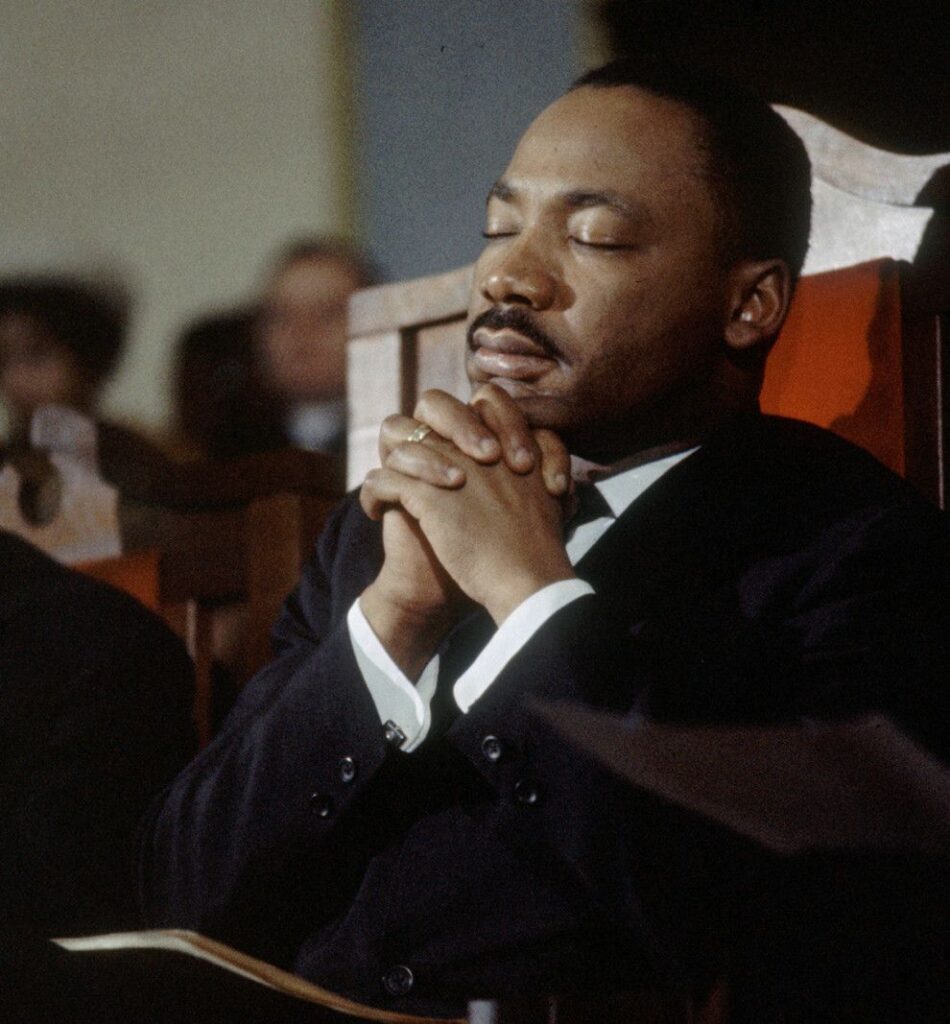
“Take the first step in faith. You don’t have to see the whole staircase, just take the first step.” These are the words of Martin Luther King, Jr, one of the greatest Christian believers in modern-day America. His dream of a just society for all Americans was reflected in both his actions and his words. His faith was in Jesus, the King of Love. He refused to use violence or destruction against white men who perpetrated violence against the Negro. He always advocated only non-violent, peaceful protests. “Darkness cannot drive out darkness: only light can do that. Hate cannot drive out hate: only love can do that.”  He spoke of unity among men and women: “We must learn to live together as brothers or perish together as fools”. Since 1948, more than 200 black churches and homes had been bombed in the South. Even after this and having witnessed torture and lynchings by mobs of vicious men, he spoke only of forgiveness: “Forgiveness is not an occasional act; it is a constant attitude … I have decided to stick with love. Hate is too great a burden to bear”. On June 11, 1963, President John F. Kennedy addressed the nation on television to urge Congress to pass comprehensive civil rights legislation and to address the ongoing struggle for racial equality in the United States. He said that any American, regardless of their skin color, should be able to eat lunch in a restaurant without intimidation, send his children to the best school available, and to vote for the public officials who will represent him. A prophet is someone who calls out our sin, but also gives us reason to hope. As MLK, Jr, once said: “We must accept finite disappointment, but never lose infinite hope”. – – – Fr. Jim

Learning to win and lose gracefully

There are many lessons we want to teach our children. One of the most important is how to deal gracefully with disappointment. On January 6, 2021, the losing candidate for the US presidency incited a riot against our nation’s Capital, nearly resulting in the death of his own vice president. Four years later, on January 6, 2025, the losing candidate certified the election results and gracefully handed over the office of the president to the new victor. As she put it, “the peaceful transfer of power is one of the most fundamental principles of American democracy. As much as any other principle, it is what distinguishes our system of government from monarchy or tyranny.” That is, there are bigger principles that transcend a single contest. Sports are a healthy way of teaching this lesson to our children. Great athletes know the discipline of getting up after a loss and again hitting the practice field and preparing for the next game. A single bad grade on an exam is sometimes the best incentive to study even harder and excel for the remainder of the course. The bigger principle, in these cases, is the joy of a game and the learning that comes in the classroom. Emotional maturity demands that we learn from our mistakes or our shortcomings and set about to correct them. Proverbs 14:25 says: “Souls are saved by truthful witness and betrayed by the spread of lies.” This proverb highlights the importance of integrity and truthfulness, even and especially in the face of defeat. A good “loser” would likely be honest about their mistakes and failures and, in turn, congratulate the “winner”. Let’s teach our children these lessons, starting at an early age, so that they may form good habits of winning and losing. – – – Fr. Jim

Becoming pilgrims of hope

It has ben said that Pope St. John Paul II was a “witness to hope”. He often spoke of a “springtime of the Church” In which good would triumph over evil and truth would be victorious over lies. Hope, along with Faith and Love, is a theological virtue. Hope is trusting in God despite disappointment at the abundance of sin in our world. During one of his visits to the United Nations, Pope JP II said that “Hope is not empty optimism….but is the premise of responsible activity that is nurtured in the inner sanctuary of conscience where man is alone with God”. In other words, hope is nurtured in prayer and is expressed in positive action, action that provides a stark contrast to sin with unconditional love of our neighbor. For example, the hope-filled Christian doesn’t just despair at the rise of homelessness. He vows to take some small part in initiatives to alleviate the housing crisis. Other examples – in times of loneliness I can put my hope in hobbies and friendships. In times of a health scare, I can put my trust in God working through doctors and nurses. Do I see God’s providence as guiding the stars as well as the challenges and blessings of my personal life and that of my family? Pope Francis has declared the new year 2025 as a Jubilee Year of Hope. St. Paul reminds us that hope, like all virtues, is the result of practice and discipline, and “hope does not disappoint” (Rom 5:3-5). – – – Fr. Jim

© 2026 The Yellow Wood

Theme by Anders Noren — Up ↑