Meditations on Faith in a World Observed

Month: October 2024

Our duty and our privilege

This Fall we have a golden duty and privilege to vote for a new president and new members of Congress. In this important season, let’s remember a few things. First, listen to the candidates speak for themselves rather than what others say about them. Watch a video or two of an actual speech or an interview of the candidate to get a sense of their top priorities and how they would govern. No candidate is perfect, and we only get one vote. (We can’t vote 2/5 for this person and 3/5 for that person.) So we use our best judgment. Secondly, don’t let people convince you that you are choosing between good and evil. We presume that both major political parties have put worthy candidates forward. This presumption is essential to making a democracy work. A political competitor is simply that – a competitor, not a demon. Thirdly, the US Catholic Bishops have offered guidance for forming our consciences during an election year. Search for “faithful citizenship” and you will find it. Finally, pray for the safety of our candidates and all election workers. Violence has no place in our democracy, and “a nation divided against itself cannot stand” (Matthew 12:25). Pope Francis wrote: “Jesus’ parable of the Good Samaritan summons all Catholics to rediscover our vocation as citizens of our respective nations and of the entire world…We are called to direct society to the pursuit of the common good and, with this purpose in mind, to persevere in consolidating its political and social order, its fabric of relations, its human goals.” Government’s role, in the end, is about creating order and the common good so that all people may flourish in their homes and work and communities. To vote is to share in this role. What a privilege! – – – Fr. Jim

Wisdom from the belly of suffering

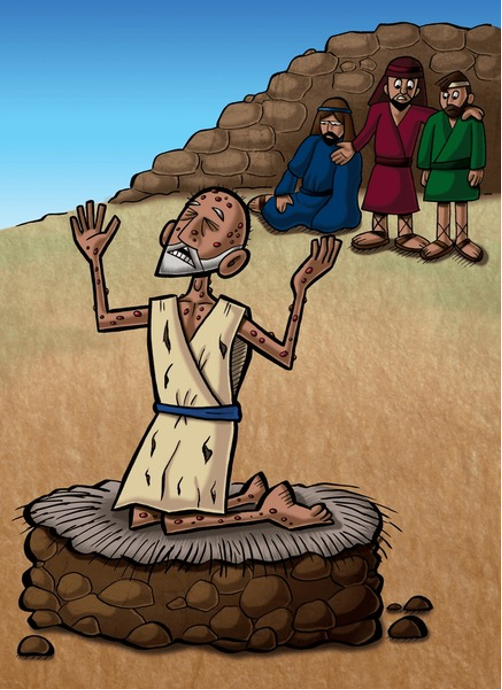
The Old Testament book of Job is a poetic classic that is often taught in college literature classes. The book deals with the deepest of human issues – Why do bad things happen to good people? How do we let go of old ways of thinking? How do we remain faithful to God amidst immense emotional and physical suffering? Job is a good man who undergoes a series of losses – first, all his cattle and means of livelihood, then his beloved children, and finally his own health as he suffers severe boils from the soles of his feet to the top of his head. Through it all, Job refused to curse God. “We accept good things from the Lord; and should we not also accept evil?” But he does curse the day of his own birth. “Perish the day when I was born…May that day be darkness.” In other words, may that day never have existed. According to Israel’s conventional wisdom, a good man will prosper. He will be blessed by God in this life and in the next. One should never have to choose between obedience and suffering. But the story of Job turns this wisdom upside down. It easy to give comfort to someone who is sick when we are healthy. It easy to give comfort to someone who has just lost a child when we have healthy children. Job gives voice to the suffering person. He says the things that a sorrowful person wants to say but can’t find the words.  That is the beauty of this book. Other books of wisdom – Proverbs, Ecclesiastes – may be reflections of a man with a full stomach writing from his study. But Job is an attempt to deal with life’s most existential questions from the vantage point of a man’s tears and pain. God only appears at the end of the book. He speaks to Job out of a storm – “Where were you when I founded the earth? …Who laid its cornerstone while the morning stars sang together?” We should not come to the book of Job looking for answers. We should come looking for companionship; someone with whom we can commiserate when our life too seems unbearable. – – – Fr. Jim

The blessings of being involved

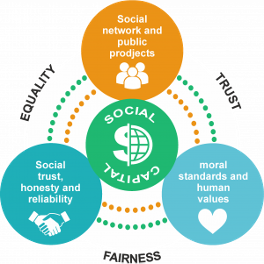
Is there a link between civil society and the success of a democracy? When the French aristocrat, Alexis de Tocqueville. toured the United States in the 1830s, he was impressed by the unprecedented way that Americans were making their democracy work. “Americans of all types are forever forming associations, groups that center around community service or common hobbies and interests.” Many parents were involved in a PTA (parent-teacher association) which helped them stay engaged in their child’s education. Knights of Columbus, Rotary and Lions Clubs, sewing circles, and garden clubs, all flourished into the 1950s. People learned how to socialize with one another in informal settings while learning the art of collaborating towards a common goal. Catholic schools were strong because parents were actively involved in raising funds. Volunteer fire fighters sold t-shirts that said: “Come to our breakfast and we’ll come to your fire.” (Ha!) Such organizations created a strong civil society in which people had a network of friends and learned how to solve problems collectively. We became more aware of our commonalities that were greater than our differences and did not need to rely so heavily on the state. We knew most of our neighbors and so we watched out for each other across the street. Researchers in the fields of education, urban poverty, and control of crime and drug abuse have discovered that success is more likely in communities where people are civically engaged in these voluntary groups. “It takes a village to raise a child” is an African proverb that means that an entire community of people must provide for and interact positively with children. Children who feel isolated or disconnected often suffer from anxiety. Do you want to make America great again? Join a group. Serve your community. – – – Fr. Jim

© 2026 The Yellow Wood

Theme by Anders Noren — Up ↑