Meditations on Faith in a World Observed

Month: May 2025

Two wings that lift us to God

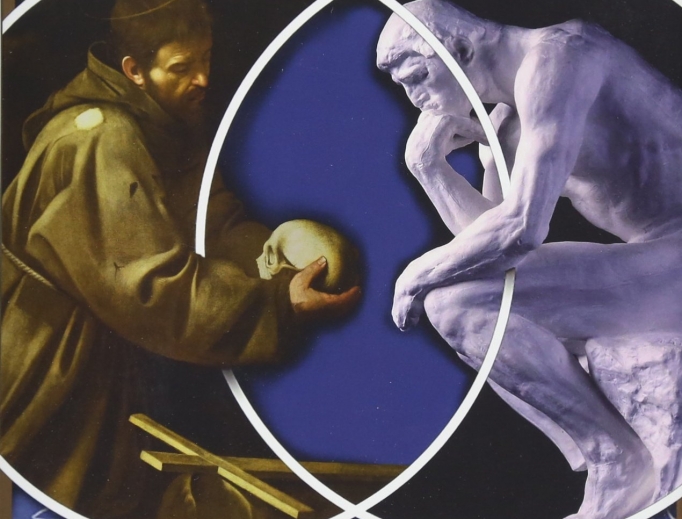
St. Pope John Paul II wrote: “Faith and reason are like two wings on which the human spirit rises to the contemplation of truth.” In other words, God gave us intelligence to uncover truths – through scientific discovery – about the natural world. He also gave us the capacity to believe in things that are beyond our visible world, to have faith in the unseen Maker. Some say that science and religion are incompatible. But God is truth, and truth will never contradict truth. A person uses reason when she asks a lot of questions; she uses faith when she trusts in someone or something. The happiest people are those who both trust and use logical reason. For example, we trust a road map because someone has already traveled the routes before us and measured all the distances. We trust an older sister who is a stockbroker and recommends that we invest in a certain stock. We know that she wouldn’t intentionally deceive us. We can’t possibly know all about a person before we marry them. But we pay close attention to their moods, habits, likes and dislikes, and we have ruled out any reasons why we should not marry this person. Then we trust, and hope, that our choice is a good one. (If we waited until we knew everything about a person, then no one would ever get married!) The same holds true with our life with God. We have known experiences of beauty, goodness, and truth, when we have felt lifted up beyond ourselves into the Transcendent. Or we know and learn of other people’s experiences of such. These personal experiences are real and can be trusted. The first letter of Peter says: “Always be ready to give … a reason for your hope, but do it with gentleness and reverence.” (1 Pet. 3:15) – – – Fr. Jim
Who was the previous Pope Leo?

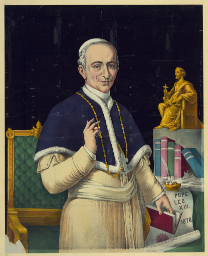
The first century world was quite different from our modern world. Jesus never had to teach his followers about church-state relations, or artificial birth control, or child labor, or environmental degradation because such things just did not exist. Catholic social teaching is the collection of teachings from the Pope and our bishops that apply Gospel principles to these modern problems. And it all began with Pope Leo XIII who published his encyclical letter, Rerum Novarum (Of a New World), in 1891. This pope lived at the height of the industrial age in Europe and the Americas. The working class was enduring the misery of long hours, unsafe working conditions, low wages, and forced child labor. One response was that taken by Karl Marx who advocated the overthrow of the ruling class and private property. In contrast, Pope Leo’s approach was more measured and respectful of human dignity and individual freedom. Against socialism, Leo affirmed the right to private property as an incentive for individual initiative and creativity. He asserted the right to a living wage rather than a contract that is imposed upon the workforce in order to generate greater profits for the owner: “Wages ought to be sufficient to support a frugal and well-behaved wage-earner.” And he affirmed the right of workers to form unions so as to better negotiate with owners over more favorable working conditions. The pope cautioned against the excesses of capitalism which can lead to a gap between economic classes. A new pope chooses his name out of respect or admiration for a previous pope and to signal the desire to follow in his footsteps. Perhaps the newly elected Pope Leo XIV, too, wants to address a new world, or, perhaps, this old world in a new way. – – – Fr. Jim

A Pope of the people

Every pastor of a Catholic parish brings his own unique set of skills and interests to the position. He will have his own perspective and priorities. The same holds true for the pastor of the global Catholic Church, the Bishop of Rome. Pope Francis was a pastor who encouraged Church ministers to “take on the smell of the sheep”. As Archbishop of Buenos Aires, he would visit the country’s villas miserias, not in a fancy car, but by bus. He would kiss the feet of the people, earning him the nickname the “priest of the slums”. Surely this practice opened his eyes to the eyes of the poorest and most vulnerable. He didn’t change church tradition, but sometimes made it more merciful. He reminded us that being Christian means being counter-cultural. Instead of bullying, we seek understanding and offer compassion, just like our Heavenly Father. As Pope, he was too liberal for the conservatives and too conservative for the liberals. In this sense then, he was like Our Lord Jesus, who came not to subvert the religious law but to give it a heart of compassion and mercy. He spoke of “building bridges rather than walls” and he followed his words with actions. He challenged us to share God’s blessings upon those who felt left out of the church, including gay couples and couples who were not married properly within the church. In his writings, he reminded us that we are called to care for God’s creation for the sake of the poor and for future generations. And he believed sharing the Gospel meant sharing joy, the joy that the disciples felt upon receiving the Holy Spirit at Pentecost. Well done, good and faithful servant. – – – Fr. Jim

Consider the lilies . . .

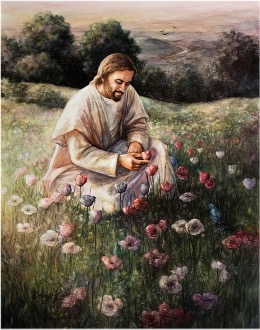
On Holy Saturday of this year, 11 men and women were confirmed and anointed at our parish with Sacred Chrism, blessed by the bishop. In the Anointing of the Sick, the priest follows the instructions of the Apostle James to anoint the sick “with oil in the name of the Lord.” (James 5:14-15), uniting the person to Christ’s Passion and offering strength in their suffering. The chrism for Confirmation and the oil for Anointing are examples of a sacramental. We celebrate seven Sacraments (capital “S”), which are events in which we encounter God is a deeper way. But there are many sacramentals (little “s”) that are sacred signs or symbols that extend the sacraments and point us to God’s graces. Candles remind us that Christ is the light that freely enters into the darkness of the world’s sin. Bells are a reminder of the heavenly choirs that ring out their glory in praise to God. Statues are visible reminders of the saints who have gone before us, showing us how to follow the Lord in their own particular circumstances. Incense is a reminder that our prayers rise up towards God as a fragrant offering of our hearts. And most importantly, holy water radiates the sacrament of our Baptism. Indeed, anything in God’s creation can become a sacramental if used in the proper way. Jesus said “Consider the lilies of the field.” Let them reveal God’s graces to you. This past week our nation celebrated Earth Day. By doing so, we consider the importance of protecting the planet and its natural resources. As people of faith, we feel called to care for God’s creation as his stewards. And as Catholics, we can also see all parts of creation as sacramentals. Stately trees, colorful flowers, and puffy clouds – all of these are invitations to fall in love again with our world….and its Creator. – – – Fr. Jim

© 2026 The Yellow Wood

Theme by Anders Noren — Up ↑