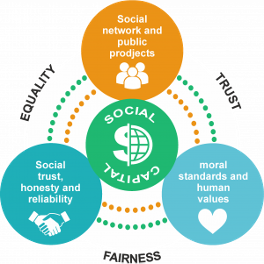
Is there a link between civil society and the success of a democracy? When the French aristocrat, Alexis de Tocqueville. toured the United States in the 1830s, he was impressed by the unprecedented way that Americans were making their democracy work. “Americans of all types are forever forming associations, groups that center around community service or common hobbies and interests.” Many parents were involved in a PTA (parent-teacher association) which helped them stay engaged in their child’s education. Knights of Columbus, Rotary and Lions Clubs, sewing circles, and garden clubs, all flourished into the 1950s. People learned how to socialize with one another in informal settings while learning the art of collaborating towards a common goal. Catholic schools were strong because parents were actively involved in raising funds. Volunteer fire fighters sold t-shirts that said: “Come to our breakfast and we’ll come to your fire.” (Ha!) Such organizations created a strong civil society in which people had a network of friends and learned how to solve problems collectively. We became more aware of our commonalities that were greater than our differences and did not need to rely so heavily on the state. We knew most of our neighbors and so we watched out for each other across the street. Researchers in the fields of education, urban poverty, and control of crime and drug abuse have discovered that success is more likely in communities where people are civically engaged in these voluntary groups. “It takes a village to raise a child” is an African proverb that means that an entire community of people must provide for and interact positively with children. Children who feel isolated or disconnected often suffer from anxiety. Do you want to make America great again? Join a group. Serve your community. – – – Fr. Jim
Amen to choosing to get involved in our communities and being the good neighbor!